Friendship Jewelry · 2026
Why Friendship Symbol Jewelry
Has Changed — and What Works Now
The split-heart BFF necklace had a good run. For at least two decades it was the definitive friendship symbol jewelry — two halves, two friends, one complete image when you stood close enough. Then something shifted. It didn’t disappear from the market, but it stopped being the obvious choice. In its place came something less immediately recognizable but considerably more personal: jewelry engraved with a name, an initial, or a date that belongs specifically to the friendship rather than to the general concept of having one. A custom name bracelet engraved with your best friend’s name, or a name anklet engraved with yours worn by her — these aren’t symbols of friendship in the abstract. They’re specific statements about one specific person, which is a more demanding and more resonant form of jewelry than a shared motif has ever managed to be.
This piece traces how friendship jewelry has evolved — what each era got right, where each approach ran into its limits, and why the current version, built on personalization rather than symbolism, holds its meaning in a way that half-hearts and infinity charms never quite could.
How We Got HereFriendship Symbol Jewelry —
Three Stages of Evolution
The split-heart necklace was genuinely clever as a concept: two separate pieces that only make sense together, worn by two people who together complete something. It communicated a specific kind of closeness — not just affection, but exclusivity. The two halves belonged to each other and to nobody else. For that reason, the BFF necklace worked. It just came with a fundamental ceiling: the friendship was being represented by a generic image that every BFF necklace in the world shared. There was nothing in the heart itself that distinguished your friendship from anyone else’s.
The problem: the symbol was the same for everyone. The friendship wasn’t.As social media changed how people thought about personal style, friendship jewelry shifted from symbolic to aesthetic. The goal was less about representing a shared relationship and more about looking good together — matching chain weights, coordinated metals, similar pendant styles bought from the same collection. This was more wearable than a split heart and more versatile across outfit contexts, but it traded emotional specificity for visual coordination. A friendship represented by two necklaces that look nice together is a friendship represented by a styling choice. That’s not nothing — but it isn’t particularly meaningful either.
The problem: beautiful together, but interchangeable with anyone else who bought the same set.The shift that defines friendship jewelry in 2026 is a move from representing the friendship to carrying the person. A name anklet engraved with her name, worn by you — or yours, worn by her — isn’t a symbol of friendship. It’s a direct statement: I carry your name with me. That’s a fundamentally different kind of jewelry, because the meaning doesn’t depend on the piece looking a certain way, matching a partner piece, or invoking a shared image. It depends only on knowing whose name is there — and the person wearing it always knows.
Why it works: the meaning belongs to the name, not the symbol. Which means it’s yours and no one else’s.“A split heart says ‘we’re close.’ A bracelet with her name says ‘I carry you with me.’ These are not the same statement — and one of them is considerably harder to replicate with someone else.”
 Why the Shift Happened
Four Reasons a Name
Outlasts Any Friendship Symbol
A heart pendant can represent a mother, a partner, a best friend, or a general love of jewelry. A piece engraved with a specific name can only represent that specific person. The exclusivity of personalized friendship jewelry isn’t just aesthetic — it’s structural. There is no ambiguity about what the piece means or who it’s for, which gives it a kind of emotional precision that no shared symbol can match.
Matching friendship jewelry requires coordination — both people need to buy in, both pieces need to be worn simultaneously for the relationship to be represented. A name necklace engraved with her name carries the friendship whether she’s wearing hers or not, whether you’re in the same city or a different country, whether you last spoke yesterday or six months ago. The friendship is represented on your body, on your terms, permanently.
A friendship symbol means what the symbol means when you buy it. A name engraved on a chain you wear every day means more in year five than it did in year one, because five years of daily presence have accumulated around it. Every ordinary morning and significant occasion the piece was there adds to rather than subtracts from its significance. The name doesn’t change; the weight it carries does.
Giving someone a piece of jewelry engraved with their name, or wearing a piece engraved with theirs, is a more significant act than giving a coordinated accessory. It requires a decision — this person specifically, this name specifically — that a generic friendship symbol doesn’t. The recipient understands immediately that they were thought of by name, not by category. That distinction is why personalized friendship jewelry has consistently produced the “I never take it off” response that matching sets rarely do.
How People Are Doing It Now —
Four Formats That Work
The shift to name-based friendship jewelry has produced several specific formats, each with its own logic and its own kind of meaning:
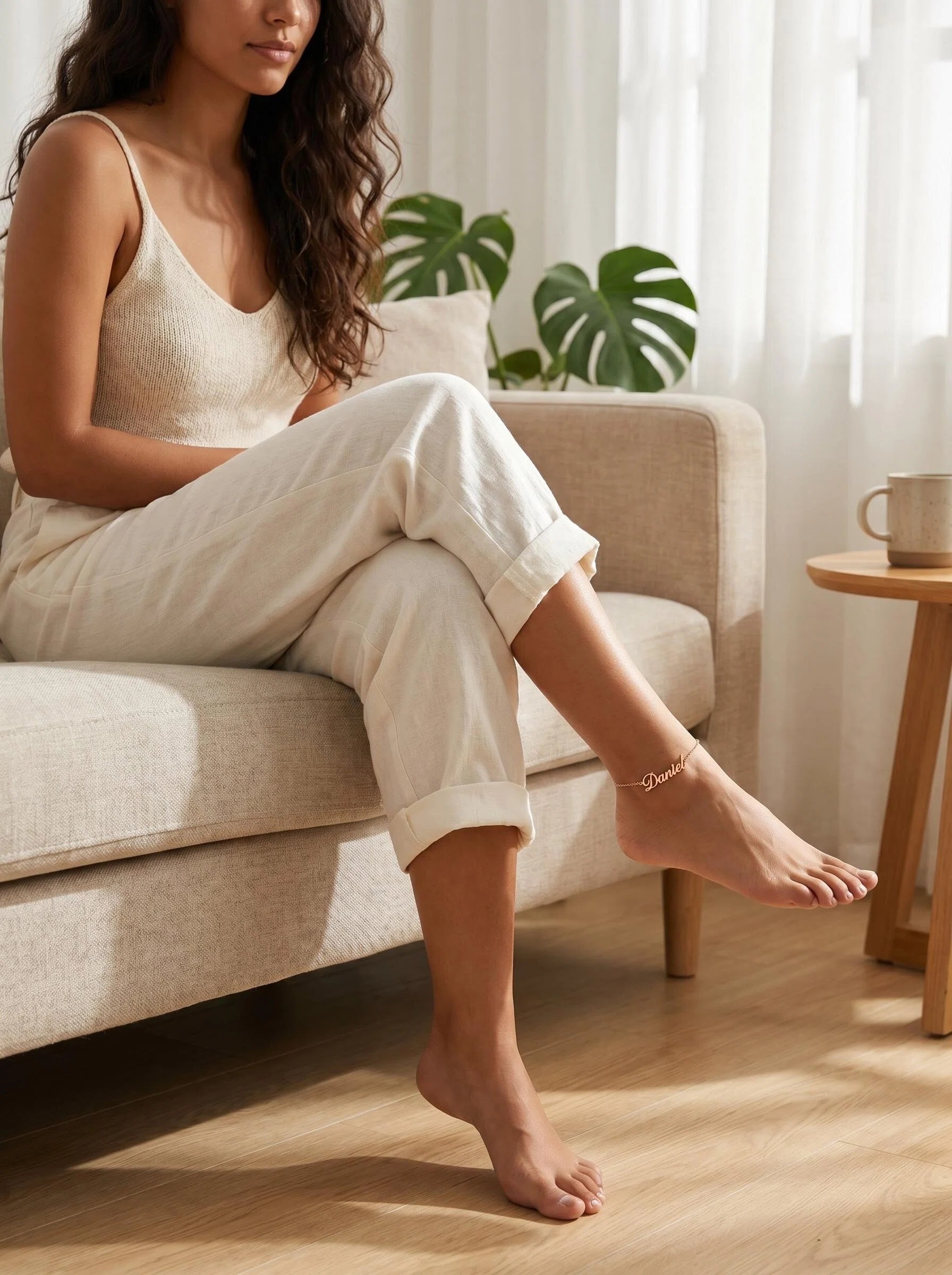
The anklet format is the most private version of name-based friendship jewelry. Worn low, not always visible, fully present in the daily life of the wearer without demanding attention from anyone else. A name anklet engraved with her name at your ankle — she wears one with yours — is a friendship represented at the level of the body rather than the aesthetic. Nobody else needs to see it. The two of you know it’s there, which is enough.
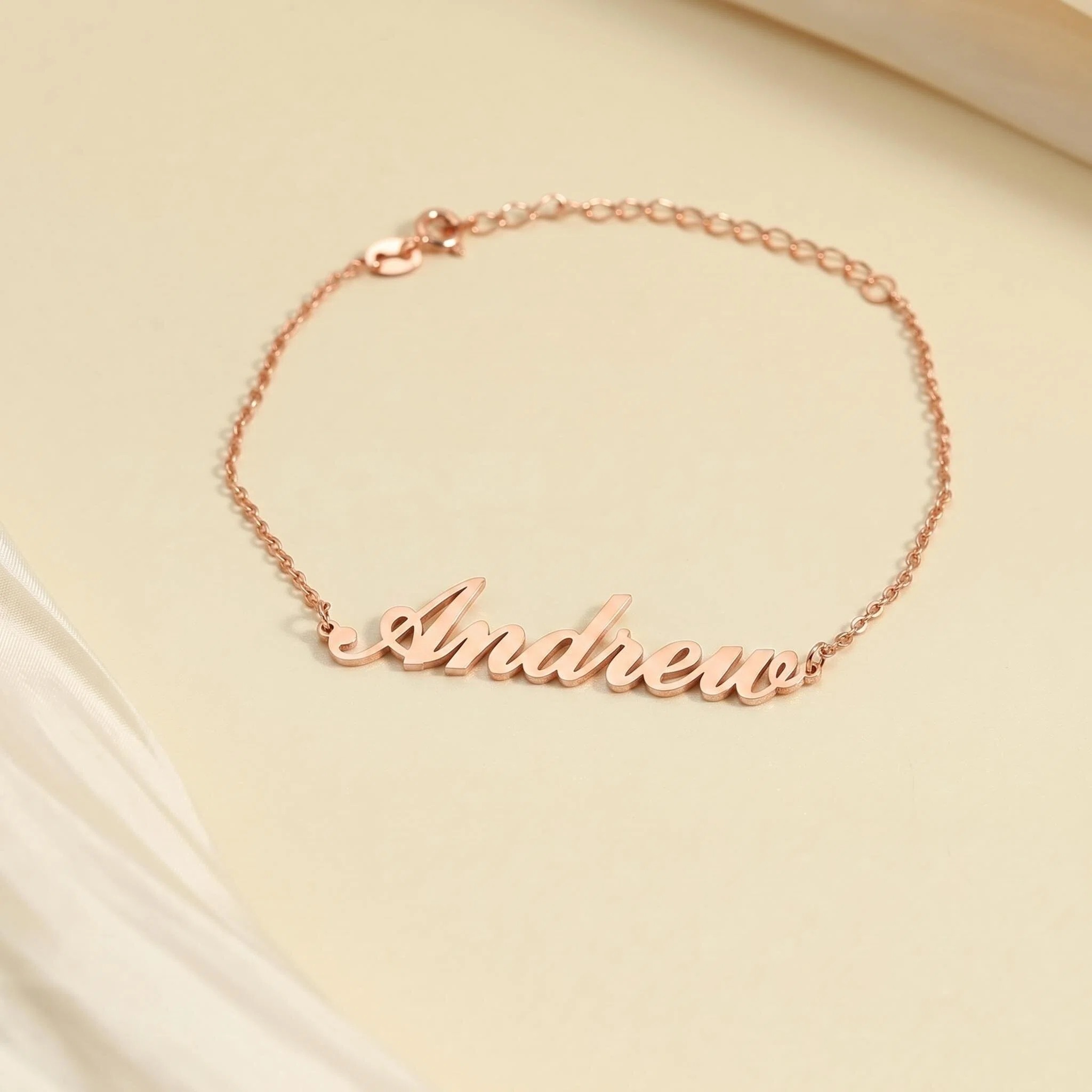
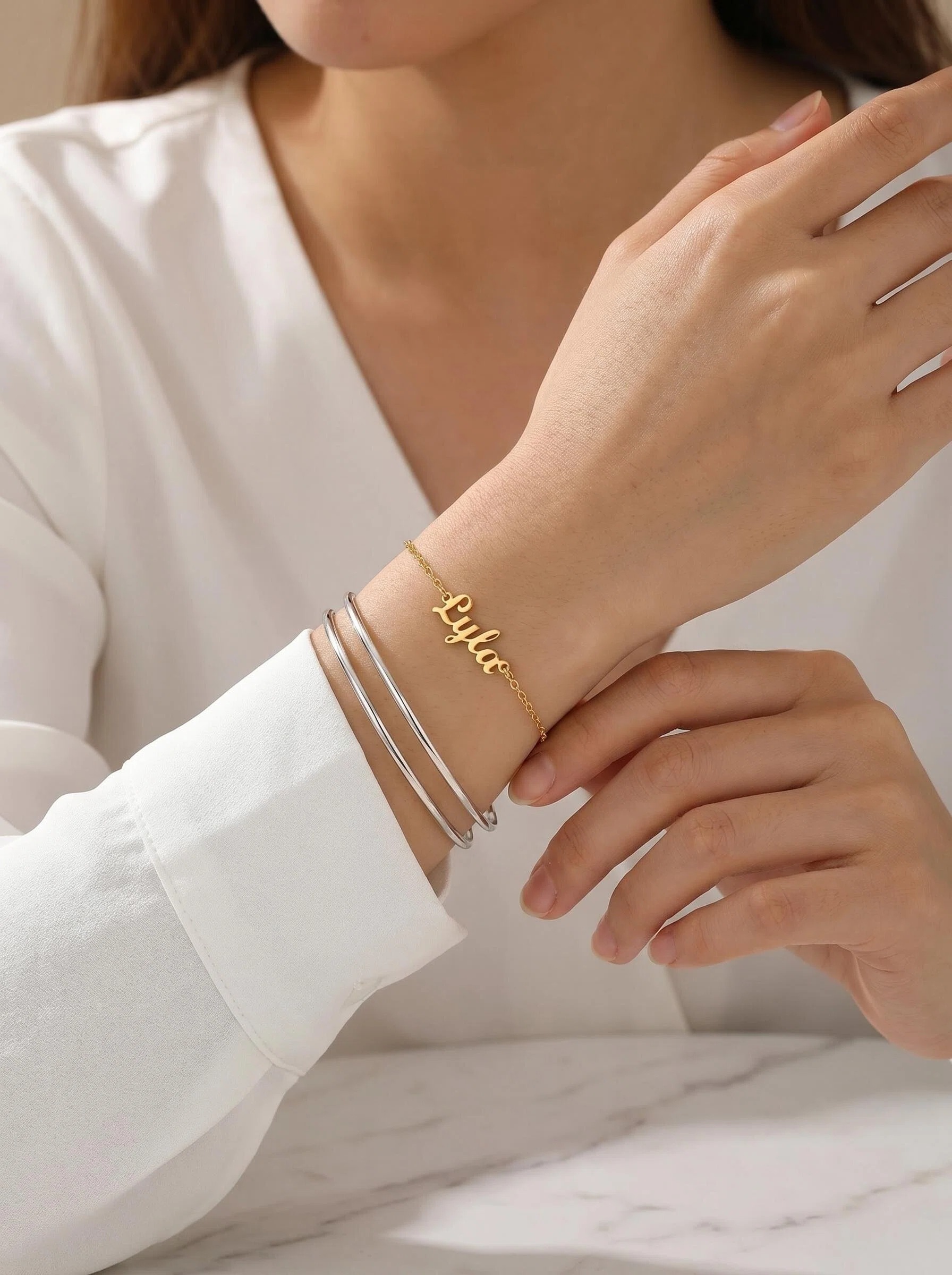
A name bracelet at the wrist is the most visible daily-wear format — present in every handshake, every gesture, every moment you reach for something. For friendships you want to carry in a more present way, the wrist makes the name part of ordinary interaction with the world. It’s also the format most naturally suited to stacking: her name alongside a date bracelet, or alongside a bracelet with your own name, creates a wrist that tells its own story.
A name necklace carrying her name sits closest to the heart — literally and symbolically. In all the body positions available for jewelry, the chest carries the most emotional weight. Engraving a friend’s name at the neckline is the most direct version of the “I carry you with me” statement. It’s also the most visible, which means the piece will be noticed and remarked on — which can itself become a way of talking about the friendship.
A single initial — hers, engraved on a chain you wear — is the most private format of all. Nobody reads a letter on a chain and immediately knows whose it is. That privacy is the point: the meaning belongs entirely to the two of you. An initial anklet or bracelet carries the friendship in a way that doesn’t require or invite external interpretation. Some friendships are simply between two people, and the jewelry that represents them can be too.
On Something I Wear Every Day”
Regardless of which format — ankle, wrist, neckline, or initial — the underlying statement of personalized friendship jewelry is the same: your name is specific enough, and our friendship is significant enough, that I wanted it present on my body. That’s a harder thing to say than “here’s a charm that means friendship.” It’s also a more honest one.
Every piece in the personalized jewelry collection — name anklet, name bracelet, name necklace — is engraved free, made from eco-friendly, hypoallergenic, waterproof, tarnish-free materials, and adjustable for a comfortable daily fit. The design is intentionally understated so that the name is the point, not the pendant. Which is how it should be.
The Best Friendship Symbol
Has Always Been a Name
The split heart worked because it communicated specificity — these two halves belong together, and implicitly, these two people do too. What the name-based format does is take that specificity one step further: not “I belong to a friendship” but “I belong to this friendship, with this person, whose name is right here.” The symbol pointed at a category. The name points at someone specific.
That’s why the evolution away from matching symbols and toward personalized engraving isn’t a departure from what friendship jewelry was always trying to do. It’s the arrival at what it was always trying to do — and just couldn’t, until the jewelry got specific enough to carry an actual name.
Her Name. Your Wrist.
The Most Personal Friendship Symbol.
Eco-friendly, hypoallergenic, tarnish-free name anklets, bracelets, and necklaces — engraved with any name, worn every day. Free engraving, ships gift-ready.
✦ Free engraving · Waterproof construction · See the full collection