
What Does White Toenail Polish
Actually Mean?
White toenail polish is most often a style signal, not a secret code — it reads as clean, fresh, minimal, and bright. It’s one of the most popular warm-weather shades because it pairs with almost everything and photographs with strong contrast.
The “white nails mean you’re single” idea that periodically resurfaces online is internet folklore, not an established meaning. Most people who wear it are simply drawn to the aesthetic.
Colour choices in beauty rarely have one fixed meaning — they’re shaped by fashion cycles, cultural context, and personal taste all at once. White toenail polish is a good example: it’s simple enough to look intentional in almost any setting, which is exactly why it keeps resurfacing as a seasonal favourite rather than fading like more novelty-driven shades.
This guide looks at what white polish actually communicates, where the symbolism comes from, how different cultures read the colour more broadly, whether the “single” rumour holds up, and the practical side of wearing a colour that shows every imperfection more clearly than almost any other.
The Core Meanings Behind White Polish
None of these are fixed rules — they’re the associations that show up most consistently when people are asked why they reach for white.
White reads as the visual equivalent of crisp linen or fresh snow — it signals cleanliness and attention to detail more directly than almost any other shade, which is part of why it holds up so well as a warm-weather default.
Because it has no undertone to interpret, white feels understated even though it’s technically a bold, high-contrast choice. It fits naturally into minimalist and quiet, uncluttered styling.
White polish is strongly tied to summer — it looks especially bright against tanned or sun-touched skin and pairs naturally with sandals, linen, and anything beach- or holiday-adjacent.
White is one of the few colours that genuinely goes with everything — neutral tones, bold prints, metallics, and nail art all sit comfortably against it, which is why it works as a dependable base rather than a statement to build around.
Because white carries associations with clean slates and new beginnings more broadly, some people choose it specifically at the start of a new season, after a change, or simply when they want something that feels reset rather than repeated.
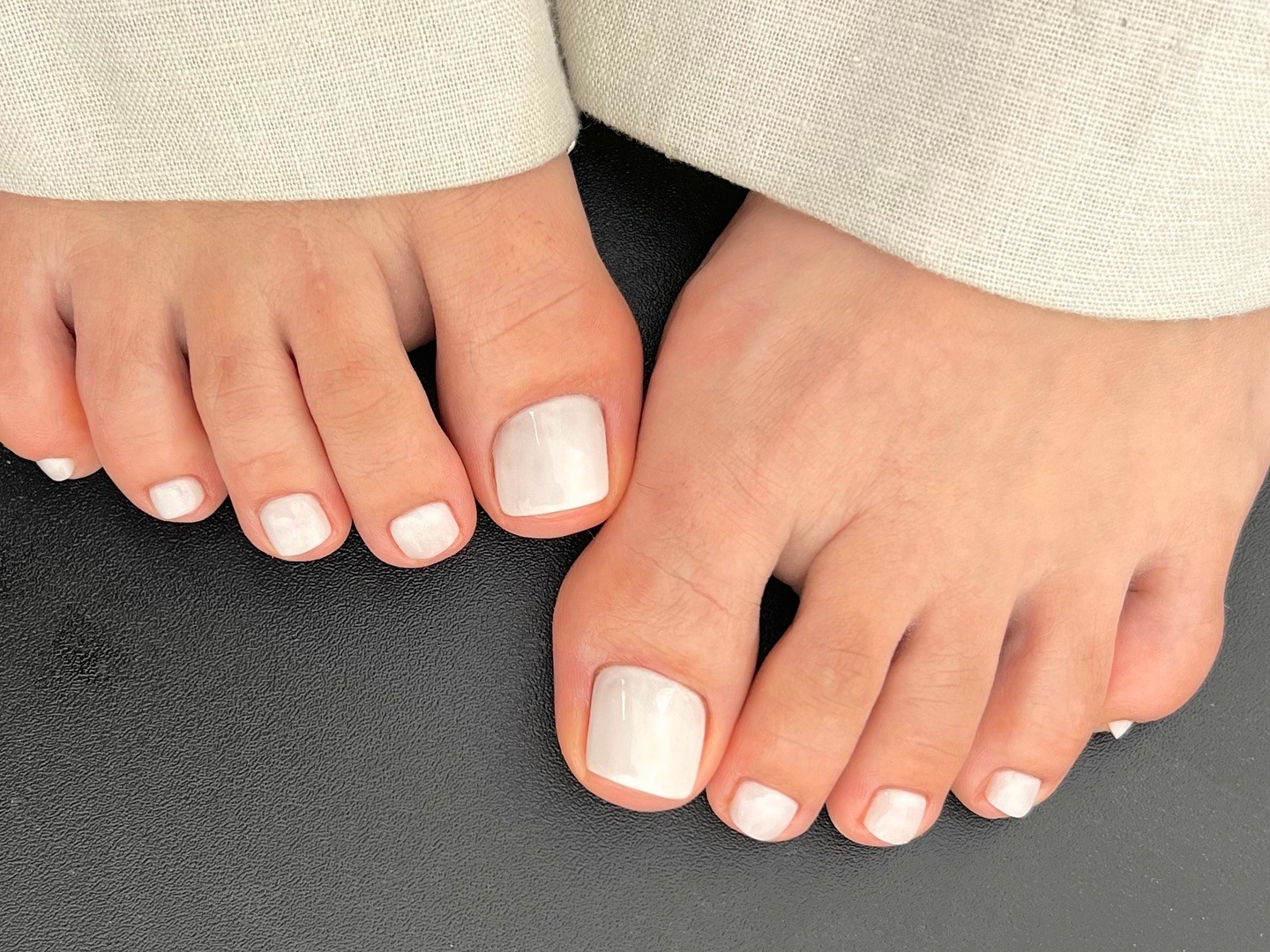
Full white nails are often worn as a modern reinterpretation of the classic French pedicure — instead of a nude base with a white tip, the entire nail becomes the clean, bright element.
White’s high contrast makes it one of the easiest colours to style jewellery against — a single anklet reads clearly without competing with the polish. A custom name anklet with free engraving, waterproof and tarnish-free.
Shop Name Anklets →What White Means Across Different Cultures
Colour symbolism doesn’t travel the same way everywhere, and white is one of the clearest examples of a colour that carries genuinely different weight depending on where — and in what context — it’s being read.
White is closely associated with weddings, purity, and new beginnings — a bride’s dress being the most obvious example. This association carries loosely into beauty choices, where white is often read as clean and celebratory.
In parts of China, Korea, and other East Asian cultures, white is traditionally the colour of mourning and funerals rather than celebration — the near-opposite association to the Western wedding context.
Across a number of religious and spiritual traditions, white is used to represent purity, peace, or a return to a neutral, unburdened state — often worn during specific rites or ceremonies.
In modern fashion and beauty spaces globally, these older associations have loosened considerably. White is now read primarily as a style choice — minimalist, bright, and versatile — more than as a symbol tied to any single tradition.
The takeaway: A single colour rarely means one universal thing. White’s meaning shifts with context — cultural background, occasion, and personal association all shape how it’s read, which is exactly why it resists being reduced to one fixed symbol.
Periodically, a claim resurfaces online that white toenail polish is a coded signal for relationship availability. It has no reliable basis, no consistent origin, and no meaningful evidence behind it — it behaves like most viral colour-symbolism claims: repeated often enough that it starts to sound established, without ever actually being established.
The far more likely explanation for why someone is wearing white polish is simpler: it’s a versatile, warm-weather shade that photographs well, pairs with almost any outfit, and doesn’t require matching to a specific colour scheme. Treating a beauty choice as a coded relationship signal says more about the assumption being made than about the person wearing it.
If you’re wearing white polish, it’s reasonable to assume most people around you are reading it exactly the way it was intended — as a clean, considered style choice.
When White Polish Works Best
- ✦Warm-weather and sandal season. White creates the strongest visual contrast against tanned or sun-warmed skin, which is part of why it’s such a consistent summer favourite.
- ✦Weddings and formal occasions. Its association with clean elegance makes it a natural fit for bridal pedicures or any event where a polished, understated look is the goal.
- ✦Minimalist or “quiet” styling. If your everyday aesthetic leans toward neutral tones and simple lines, white polish extends that same restraint down to your feet rather than introducing a competing colour.
- ✦As a base for nail art. White’s brightness makes any design painted over or alongside it — dots, lines, French details — read with more clarity than it would over a darker base.
- ✦Whenever you want feet to look immediately well-groomed. Because white shows so clearly, it also signals — at a glance — that the polish is fresh and the nails are well-kept, which is part of its appeal for anyone who wants a low-effort, high-clarity look.
White vs. Other Common Toenail Colours
Seeing white against a handful of other everyday choices makes its particular appeal clearer — it occupies a different register from almost every other shade on this list.
| Colour | General Association | Best Suited To |
|---|---|---|
| White | Clean, minimal, versatile, fresh | Summer, weddings, minimalist styling, any outfit |
| Red | Bold, classic, confident | Evening looks, timeless glamour, high contrast |
| Nude | Understated, professional, natural | Everyday wear, low-key elegance |
| Black | Edgy, dramatic, unconventional | Alternative styling, statement looks |
| Pastel pink | Soft, sweet, traditionally feminine | Spring, romantic or delicate aesthetics |
Keeping White Polish Looking Clean, Not Dingy
White is unforgiving in a way most colours aren’t — it has no pigment to hide behind, so ridges, chips, and yellowing all show up faster and more visibly. A little extra care goes further with white than with almost any other shade.
White amplifies any texture on the nail surface. A ridge-filling base smooths the surface before colour goes on, which prevents the streaky, uneven look that plain white polish often develops over a textured nail bed.
Some white polishes yellow with sun exposure over a few days — ironic, given how often white is worn specifically for summer. Look for formulas marketed as UV-stable or discolouration-resistant if you’re wearing it through a lot of direct sun.
Thick coats of white are more prone to visible cracking and chipping at the tip. Two thin coats, each sealed by dragging the brush over the free edge of the nail, hold their clean look considerably longer than one thick layer.
Because any wear is so visible against white, a light topcoat refresh every three to four days keeps the surface glossy and even, and covers over the earliest, smallest chips before they become noticeable.
White, Milky White, or Glazed —
What’s the Difference?
“White polish” isn’t actually one single look. There are a few distinct finishes worth knowing before you pick a bottle:
Solid white is fully opaque — bright, high-contrast, and the most classic version of the colour. It shows the most texture and requires the most upkeep, but it’s also the version with the clearest, cleanest visual impact.
Milky or “glazed” white is sheer and slightly translucent, allowing some of the natural nail tone to show through underneath. It reads as softer and more diffused than solid white, and — because it’s less opaque — it tends to disguise small imperfections and regrowth more effectively than the fully solid version.
Neither is objectively better. Solid white gives maximum contrast and a crisper look; milky white gives a gentler, lower-maintenance alternative that still reads as clean and minimal.