Symbolism · History · Style
Evil Eye Anklet Meaning:
The Ancient Symbol That Became Fashion’s Most Wanted Charm
The evil eye is one of the oldest symbols in human history — and one of the few that has crossed from ancient protective talisman to mainstream fashion without losing its meaning along the way. Most people who wear it today know it has something to do with protection. Fewer know where that belief comes from, why the color matters, or what it means when the charm appears specifically on the ankle rather than around the neck. This guide covers all of that — the history, the cultural significance, the modern fashion context, and how to wear an evil eye anklet in a way that honors both the symbol and your own style. If you’re looking for ankle jewelry that carries personal meaning alongside protective symbolism, the two are easier to combine than most people expect.
The short version: the evil eye is a belief in the harmful power of an envious gaze, and the evil eye symbol is a counter-charm designed to deflect that energy. It has appeared independently in cultures across the Mediterranean, Middle East, North Africa, South Asia, and Latin America — which says something about how universal the underlying concern is. The symbol you see on jewelry today is a direct descendent of amulets that have been worn for over three thousand years.
Section OneWhere the Evil Eye
Symbol Comes From
The belief in the evil eye — the idea that an envious or malevolent gaze can cause harm to the person it lands on — is one of the most widely documented superstitions in human history. Archaeological evidence places it in ancient Mesopotamia around 3,000 BCE, with references appearing in ancient Greek, Roman, Jewish, Islamic, and Hindu texts across thousands of years of recorded history. It’s not a fringe belief from a single culture; it’s a near-universal human concern that emerged independently across cultures with no direct contact with each other.
The Greek word mati (μάτι) means eye, and the evil eye belief is deeply embedded in Greek culture. Blue eye-shaped amulets have been worn for protection across Greece for millennia and remain central to Greek jewelry and folk tradition today. The symbol is called nazar in Turkish culture, where it has an equally long history.
The evil eye belief appears in Islamic tradition as al-ayn and is referenced in the Quran. Protective amulets — particularly the hamsa hand, often combined with an eye symbol — are used across Arab, Persian, and North African cultures as a defense against envious gazes.
In India, the evil eye is known as nazar, and protection against it is woven into everyday life — from black kohl on a child’s face to protective amulets worn on the body. The concern is particularly strong around newborns, new possessions, and visible success, all seen as targets for envious energy.
Brought to the Americas through Spanish and Portuguese colonization, mal de ojo (literally “evil eye”) became integrated with indigenous beliefs and remains a significant cultural concept across Mexico, Central America, and South America. Red and blue eye charms are worn widely as protection.
“A symbol that appears independently across ancient Greece, Mesopotamia, India, and the Americas isn’t a trend. It’s a human constant — the almost universal belief that envy has power, and that power can be redirected.”
Why the Evil Eye
Is Always Blue
The connection between blue and the evil eye isn’t arbitrary. In ancient Mediterranean and Middle Eastern cultures, blue eyes were rare and therefore associated with unusual power — specifically the power to curse with a gaze. The logic of the protective amulet followed from this: an eye-shaped charm in the same piercing blue would meet that gaze and deflect it, like repelling like.
Blue was also associated with the sky and the sea — elements believed in many cultures to represent divine protection and the infinite. A blue eye charm thus carried a double layer of meaning: the deflecting power of the gaze it mimicked, and the protective energy of the color itself. Over millennia this association solidified to the point where the color became inseparable from the symbol. Today, an evil eye charm in any other color reads as decorative rather than protective to anyone familiar with the tradition.
Mimics the gaze it deflects — using the same form as the threat to neutralize it. The eye watches back at whatever is watching you.
Associated with rare, powerful gazes in ancient Mediterranean cultures and with the protective infinity of sky and sea. Dark blue at center, lighter blue on the outer ring.
Represents clarity and purity — a clean field around the protective eye that keeps the deflecting power focused.
The pupil of the eye — the point of focus. In some traditions, the dark center absorbs negative energy before it can reach the wearer.
Why the Ankle —
The Significance of Placement
The placement of a protective charm matters in most traditions that use them. The ankle is one of the oldest sites for protective jewelry precisely because it’s the part of the body closest to the earth — the contact point between person and ground. In several ancient traditions, the foot and ankle were believed to be where energy enters and exits the body, making protective jewelry at the ankle a logical first line of defense.
In Indian tradition, anklets have been worn as protective and auspicious jewelry for thousands of years, and the combination of evil eye and ankle jewelry is a natural one within that context. In Mediterranean cultures, the ankle was also seen as a vulnerable point — visible when walking, exposed in sandals, a natural target for an envious gaze directed at a person’s movement and freedom. A protective charm worn there addressed that specific vulnerability.
From a modern perspective, the ankle placement also has a practical advantage over neck or wrist placement: an evil eye anklet is visible at the right moments — barefoot at the beach, with sandals in summer, close-up in photographs — without being the first thing anyone sees when they look at you. It sits at the edge of the look, carrying its meaning for those who know to look for it.
Section FourHow It Became
a Fashion Symbol
The evil eye’s transition from protective talisman to fashion staple happened gradually through the 20th century as Mediterranean and Middle Eastern aesthetic influences entered Western fashion. By the 1990s and 2000s, the symbol had appeared in high fashion collections, celebrity jewelry, and mainstream retail — worn by people who knew its history and by people who simply found the blue eye-shaped charm visually compelling.
What kept it from becoming purely decorative — the fate of many symbols that enter fashion — is that the meaning is sticky. Once you know what the evil eye represents, it’s difficult to unknow. The symbol carries its protective intention even when worn casually, which is part of why it’s remained in fashion for decades rather than cycling out like other trend-driven imagery. It means something specific, and that meaning is broadly understood across cultures.
Social media accelerated its reach from the 2010s onward. The symbol photographs exceptionally well — the concentric circles of blue, white, and black are visually distinctive at any scale — and the story behind it is short enough to explain in a caption. By 2026, the evil eye is one of the most widely worn protective symbols in the world, appearing on everything from high-end jewelry to mass market accessories, across cultures that have their own long traditions with it and cultures encountering it for the first time.
Section FiveHow to Wear and Style
an Evil Eye Anklet
The evil eye charm is versatile enough to work across most jewelry styles, but the anklet format has specific considerations worth knowing before you wear it.
-
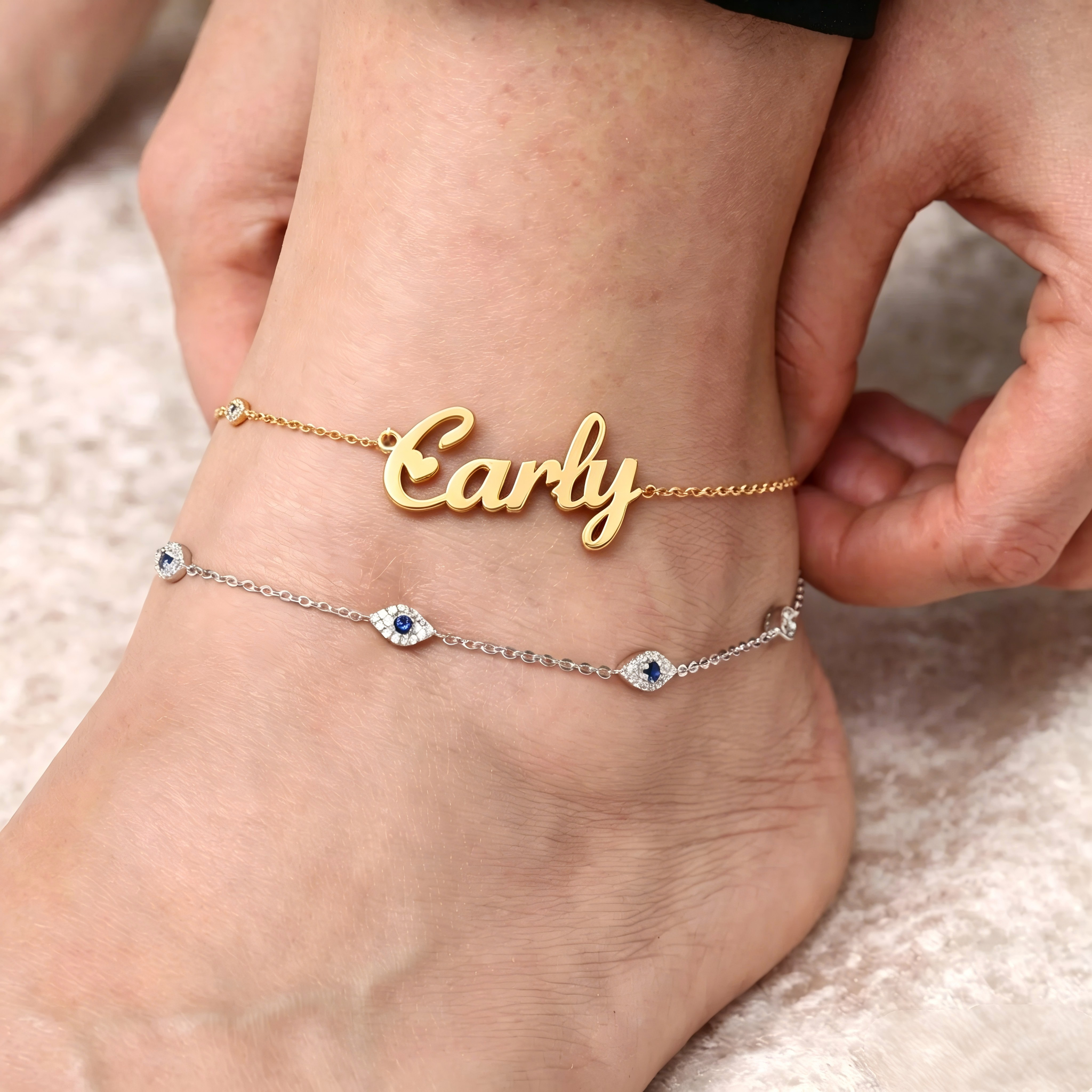
👁Wear it alone or with a plain chain — the evil eye charm is a focal point. Pairing it with an anklet that has its own charm or pendant creates visual competition. A plain fine chain alongside an evil eye anklet reads as layering; two charm-heavy anklets together reads as busy.
-
🔵Let the blue speak — the color is the symbol. Don’t mix it with other colored charms or beads in the same piece. If you’re layering multiple anklets, keep the others metallic and plain so the blue eye reads as the intentional focal point.
-
✦Pair with a personalized piece for contrast — an evil eye anklet alongside a custom name anklet creates a combination that’s both protective and personal. The eye handles the symbolic layer; the name carries the individual identity. Together they read as a considered stack rather than random accumulation.
-
☀️Summer and beach contexts are its natural home — the evil eye anklet photographs beautifully against bare skin and shows best in sandals or barefoot. It’s not excluded from other seasons, but it earns its place most naturally in the warmer months.
-
🎁Waterproof materials extend its life considerably — an evil eye charm on a chain that tarnishes or deteriorates in water defeats the purpose of daily protective wear. Look for eco-friendly, hypoallergenic, tarnish-free construction if you want a piece that stays on through everything.
Evil Eye Anklet
as a Gift
Giving an evil eye anklet as a gift carries a specific meaning that most other jewelry gifts don’t: you’re giving someone protection. Not in a literal or superstitious sense necessarily — but in the sense of saying “I’m thinking about what surrounds you, not just what adorns you.” That’s a more considered sentiment than most jewelry gifts communicate, and it’s one that resonates across cultures familiar with the symbol’s history.
It works particularly well as a gift for someone starting something new — a new job, a new city, a new chapter. The protective intention of the symbol is especially apt at transitions, when a person is more exposed to the unknowns of a new environment. An evil eye anklet given at that moment is a way of marking the transition and accompanying the person into it.
An evil eye charm alongside a date or initial anklet creates a gift that’s both protective and personal — the eye carries the universal symbolic meaning, and the engraving makes it specific to one person. Browse the full range of engraved anklet styles to find the personalized piece that best complements the evil eye charm for the person you’re giving it to.
Frequently Asked
Questions
A Symbol That Has
Outlasted Every Trend
Most symbols that enter fashion disappear within a season or two. The evil eye has been in continuous use for over three thousand years, which suggests it’s doing something more than looking good. It carries a meaning that resonates across cultures and eras — the idea that protection is worth wearing, that intention can be held in an object, that what surrounds you matters as much as what you achieve.
Whether you wear it for its history, for its visual appeal, or for the quiet sense that it’s watching your back — it earns its place on your ankle. And if you want to combine it with something more specifically yours, the custom name and date anklet styles pair naturally with any evil eye charm — worn at slightly different heights so both are visible, carrying the universal meaning of one alongside the personal meaning of the other.
Protection Is Better When
It Also Carries Your Name
Personalized custom anklets — eco-friendly, hypoallergenic, waterproof. Engraved with a name, date, or initial. Pair yours with an evil eye charm for a stack that means something on every level.
✦ Free personalization · Adjustable fit · See all engraved styles