Infant Bracelet Size Guide
Infant Bracelet Size —
Newborn to Toddler, Complete Guide
Infant wrists are smaller than most people expect — a newborn’s wrist typically measures just 9–10cm, and most adult bracelets won’t fit until a child is at least three. Getting the right infant bracelet size matters both for comfort and safety: a bracelet that’s too tight restricts circulation on a growing wrist, and one that’s too loose can become a hazard for an infant who puts everything in their mouth. This guide covers infant bracelet sizes from newborn through toddler age, how to measure a baby’s wrist, and the safest bracelet styles for each stage. For older children aged 4 and up, see our full children’s bracelet size guide.
The short answer: newborn bracelets should measure 10–11cm, infant bracelets (3–12 months) 11–12cm, and toddler bracelets (1–3 years) 12–14cm. At all infant ages, adjustable bracelets are the safest and most practical choice — they accommodate rapid wrist growth and avoid the problem of a bracelet becoming too tight between wearings.
0–3 months
3–12 months
1–2 years
2–3 years
Infant Bracelet Size
at Each Stage
Wrist size changes fastest in the first two years of life. What fits a newborn won’t fit the same baby at six months — and a three-year-old’s wrist is nearly twice the circumference of a newborn’s. Here’s what to expect at each stage.
A newborn’s wrist measures approximately 9–10cm in circumference — smaller than most people expect when they first hold a baby. Standard infant jewellery labelled “newborn size” is typically 10–11cm, giving 1cm of ease. This 1cm gap is important: it keeps the bracelet from pressing on delicate skin while preventing it from slipping over a tiny hand. Newborn bracelets should always be worn with direct adult supervision and removed during sleep.
→ Look for bracelets specifically labelled “newborn size” or “0–3 months”. Most adult bracelets — even those sold as “small” — will not fit a newborn safely.Wrist growth in the first year of life is significant but uneven — most growth happens in the first six months, then slows. By six months, a baby’s wrist is typically around 10.5cm; by twelve months it reaches 11cm. A bracelet bought at three months may be snug by six months. Adjustable infant bracelets are the most practical choice at this stage precisely because of this rapid change.
→ 11.5cm is a reliable midpoint for the 3–12 month range. Choose adjustable when possible.After the first birthday, wrist growth slows — most children add only about 1cm to their wrist circumference between ages one and two. A bracelet in the 12–13cm range fits most one-year-olds comfortably and may still fit at eighteen months. At this age, children are mobile and curious, so secure clasps and the absence of small detachable parts matter more than ever.
By age two, many children’s wrists are entering the lower range of general children’s bracelet sizing. A 13–14cm bracelet is the point where infant-specific sizing transitions into standard children’s sizing. At age three, a 14cm bracelet with 1cm ease is appropriate for most children — and a bracelet bought at this age may fit comfortably for two or more years, making it a better candidate for engraved or personalised pieces.
→ Age 2–3 is when plated jewelry becomes safer — and the perfect time to introduce a first engraved kids bracelet with her name.Infant Bracelet Size Chart —
Newborn to Toddler
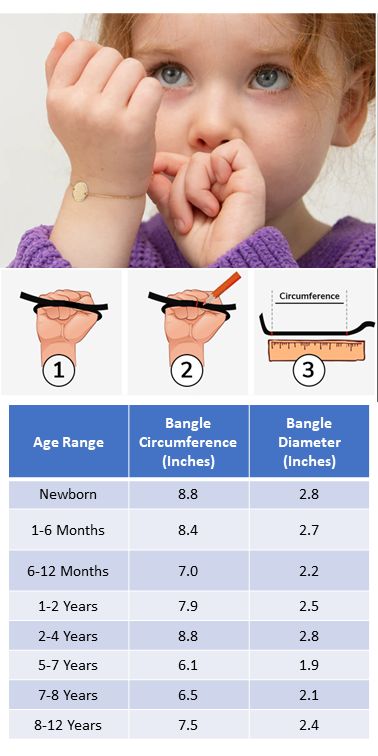
| Age | Avg Wrist | Bracelet Size | Key Consideration |
|---|---|---|---|
| Newborn (0–1 mo) | 9–9.5cm / 3.5″ | 10–10.5cm / 4″ | Supervision only; no fixed-length |
| 0–3 months | 9.5–10cm / 3.7–4″ | 10.5–11cm / 4.1–4.3″ | Adjustable strongly recommended |
| 3–6 months | 10–10.5cm / 4–4.1″ | 11–11.5cm / 4.3–4.5″ | Check fit monthly — growing fast |
| 6–12 months | 10.5–11cm / 4.1–4.3″ | 11.5–12cm / 4.5–4.7″ | No small charms or loose beads |
| 12–18 months | 11–11.5cm / 4.3–4.5″ | 12–12.5cm / 4.7–5″ | Secure clasp; check fit every 3 months |
| 18–24 months | 11.5–12cm / 4.5–4.7″ | 12.5–13cm / 5–5.1″ | Approaching toddler sizing |
| 2–3 years | 12–13cm / 4.7–5.1″ | 13–14cm / 5.1–5.5″ | Good age for first personalised piece |
| 4–6 years (ref.) | 13–14cm / 5.1–5.5″ | 14–15cm / 5.5–6″ | See children’s bracelet guide |
These are averages. Infant sizes vary more than adult sizes — always measure where possible and recheck fit regularly as babies grow quickly.
Safety FirstInfant Bracelet Safety —
What to Know Before You Buy
Infant jewelry requires different considerations than jewelry for older children or adults. Babies are at a distinct stage of development — they put things in their mouths, cannot communicate discomfort, and grow rapidly. Here’s what to keep in mind.
Infant wrists grow quickly — particularly in the first six months. A bracelet that fits well in January may be uncomfortably snug by April. Check the fit at least monthly for newborns and every 6–8 weeks for older infants. You should be able to slide one finger comfortably between the bracelet and the wrist.
Infant bracelets should be removed before sleep, naps, and any period when the child is not under direct supervision. This applies regardless of bracelet design — even a well-fitted piece can shift during sleep and become a concern.
Infants and toddlers put objects in their mouths. Avoid bracelets with small charms, beads, or any component that could detach. A single engraved bar or smooth chain is significantly safer than decorative charm bracelets at this age.
For infants, solid gold or solid silver braided/woven bracelets are the safest material choice. Plated jewelry — even high-quality IP or vacuum plating — carries a small risk of surface wear that isn’t appropriate for a baby who puts everything in their mouth. A simple woven cord or solid metal bangle in pure gold or silver has no coating to chip and is gentle against newborn skin. Save engraved or plated pieces for when the child is older and past the mouthing stage.
“An adjustable bracelet isn’t just more convenient for an infant — it’s significantly safer. A fixed-length bracelet can become too tight between wearings without anyone noticing. An adjustable one can be loosened the moment the fit changes.”
How to Measure a Baby’s Wrist
Accurately and Quickly
Measuring an infant’s wrist is easier when done at the right moment and with the right method. Here’s how to get an accurate reading even from a wriggling baby.
A calm or sleeping infant holds still long enough for an accurate measurement. Measure around the wrist just above the wrist bone — the same position where a bracelet will sit. Use a soft tape measure or a piece of string you can then measure flat against a ruler.
The tape measure or string should sit against the skin without pressing in. If it leaves a mark when removed, it was too tight. The reading you get is the wrist circumference — add 1–1.5cm to get the bracelet length for a safe infant fit.
Add at least 1cm to the wrist measurement for a comfortable bracelet fit. For infants under six months, add 1.5cm — the extra room accounts for rapid growth and means the bracelet remains safely wearable for longer before needing to be adjusted or replaced. Example: 10cm wrist + 1.5cm ease = 11.5cm bracelet.
Infant Bracelets as Gifts —
What New Parents Actually Want
For the Mother, Not the Infant
One of the most meaningful infant-occasion gifts isn’t a bracelet for the baby at all — it’s a personalised bracelet for the mother, engraved with the baby’s name or birth date. She can wear it immediately, won’t outgrow it, and carries the baby’s name on her wrist every day. It’s a more practical and emotionally lasting version of the same intention.
From Infant to Child — The Natural Next Step
Once your child is past the mouthing stage — typically around age 2–3 — plated jewelry becomes a safe and practical choice. This is the ideal time to introduce a first engraved piece: a kids bracelet with her name engraved on the bar is adjustable (12–15cm, fitting ages 2–10+), hypoallergenic, and made to grow with her. More personal than a plain bangle, more durable than infant jewelry, and something she can wear every day through childhood.
Infant Bracelet Size —
The Short Version
Newborn bracelets should measure 10–11cm; infant bracelets for 3–12 months should be 11–12cm; toddler bracelets for ages 1–3 should be 12–14cm. At every infant age, adjustable bracelets are the safest and most practical choice — they fit longer, accommodate rapid wrist growth, and can be adjusted if the fit changes between wearings. Always check the fit regularly, remove during sleep and unsupervised time, and avoid bracelets with small parts at this age.
For children aged 4 and up, see our full children’s bracelet size guide covering school-age children through teenagers.
Their Name. Engraved Free.
Adjustable, Waterproof, Gift-Ready.
Eco-friendly, hypoallergenic, tarnish-free. A name bracelet for the mother — or an adjustable first bracelet for the child. Free engraving on every order.
✦ Free engraving · Adjustable fit · See the full collection